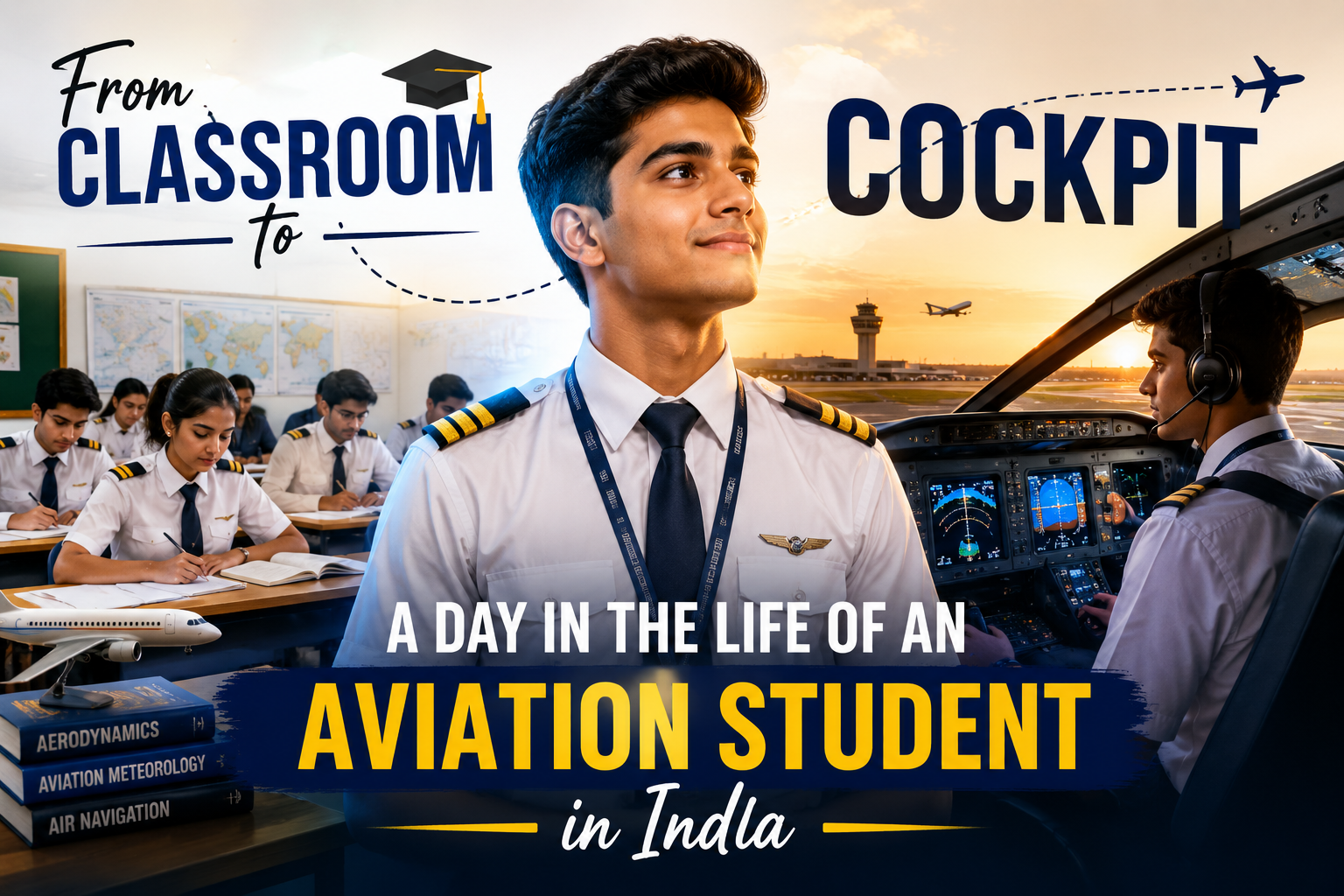
Most people have a vague sense that aviation training is glamorous. Fewer people know
what it actually looks like day to day. If you’re considering a career in aviation — as cabin
crew, a pilot, or an airport management professional — you probably want to know: what am
I signing up for?
Here is an honest, grounded look at what life as an aviation student actually involves, and
why every day of the training is building something real.
6:30 AM — The Day Starts Early
Aviation doesn’t operate on a 9-to-5 schedule, and neither does the training that prepares
you for it. Most aviation students are up early, groomed, uniformed, and ready well before
the first session. This isn’t arbitrary — it’s the first lesson. The industry you’re entering runs
on precision and discipline. Learning to show up sharp and on time is part of the curriculum
whether it appears on the timetable or not.
Morning Sessions — Safety, Procedure, and Ground Knowledge
The morning block typically covers the technical and procedural foundations of aviation. For
cabin crew students, this means deep dives into aircraft safety systems, emergency
evacuation procedures, first aid protocols, fire-fighting techniques, and passenger handling
in critical situations. For pilot ground school students, mornings are spent on meteorology,
navigation theory, air law, and flight instruments.
This content is demanding. Aviation is a safety-critical industry. The training reflects that
reality — and students often say this is the part of their education that shifts their mindset
most dramatically. You realize very quickly that the uniform isn’t just about looking good. The
training is about being ready for anything.
Midday — Communication, Hospitality, and Soft Skills
After the technical morning, the afternoon typically shifts to communication training,
hospitality standards, passenger psychology, and service excellence. Cabin crew students
practice announcements, practice difficult passenger scenarios, and learn the art of making
people feel genuinely cared for — even at 35,000 feet with 300 people to attend to.
Airport management students dive into operations simulations, learning how terminals,
check-in systems, baggage handling, and airside logistics are coordinated in real time.
These sessions are hands-on, often role-play based, and frequently where students discover
untapped strengths. Many students come into training thinking the technical content is the
hardest part. They often find that truly connecting with people, reading a situation, and
communicating under pressure is where the real growth happens.
Late Afternoon — Grooming, Presentation, and Personal Brand
Aviation has always been an industry that values presentation. This is not vanity — it is
professionalism. Grooming and presentation sessions teach students how to carry
themselves, how to dress to international airline standards, how to speak, stand, and move
in ways that project competence and confidence.
For many students, particularly those from smaller cities or towns, this is a transformative
experience. They leave these sessions not just looking different but feeling genuinely more
confident in professional environments.
Evening — Self-Study, Revision, and Peer Learning
Aviation training is intensive. Evenings are often spent in self-study — reviewing the day’s
content, preparing for assessments, practicing mock interview techniques, and connecting
with peers who are on the same journey. The community formed in aviation training is one of
the most underrated aspects of the experience. Your batchmates become your network, your
support system, and often your colleagues for years to come.
The Bigger Picture: Every Day Is Building Your Future
What makes aviation training different from a generic professional course is the clarity of
destination. You know what you’re training for. You can picture the uniform, the aircraft, the
airport. The gap between student and professional closes a little more each day.
At FlyGlam Academy, our programs are built around this principle. Everything — from the
schedule structure to the simulated drills to the airline-aligned grooming standards — is
designed to produce graduates who don’t just have certificates but are genuinely ready to
walk into their first role and perform.
If this sounds like the life you want to be living, FlyGlam Academy is where that life begins. Explore our cabin crew, pilot ground school, and airport management programs today.