Artificial intelligence is everywhere. It is writing emails, diagnosing diseases, generating
code, creating art, and passing law exams. If you are a student or a young professional in
2025, the question sitting quietly at the back of your mind is probably this: will AI take my
job?
It is a fair and important question. But here is the answer that most career guides miss: not
all jobs are equally at risk, and some careers are structured in ways that make AI
replacement not just difficult but fundamentally impossible in the foreseeable future.
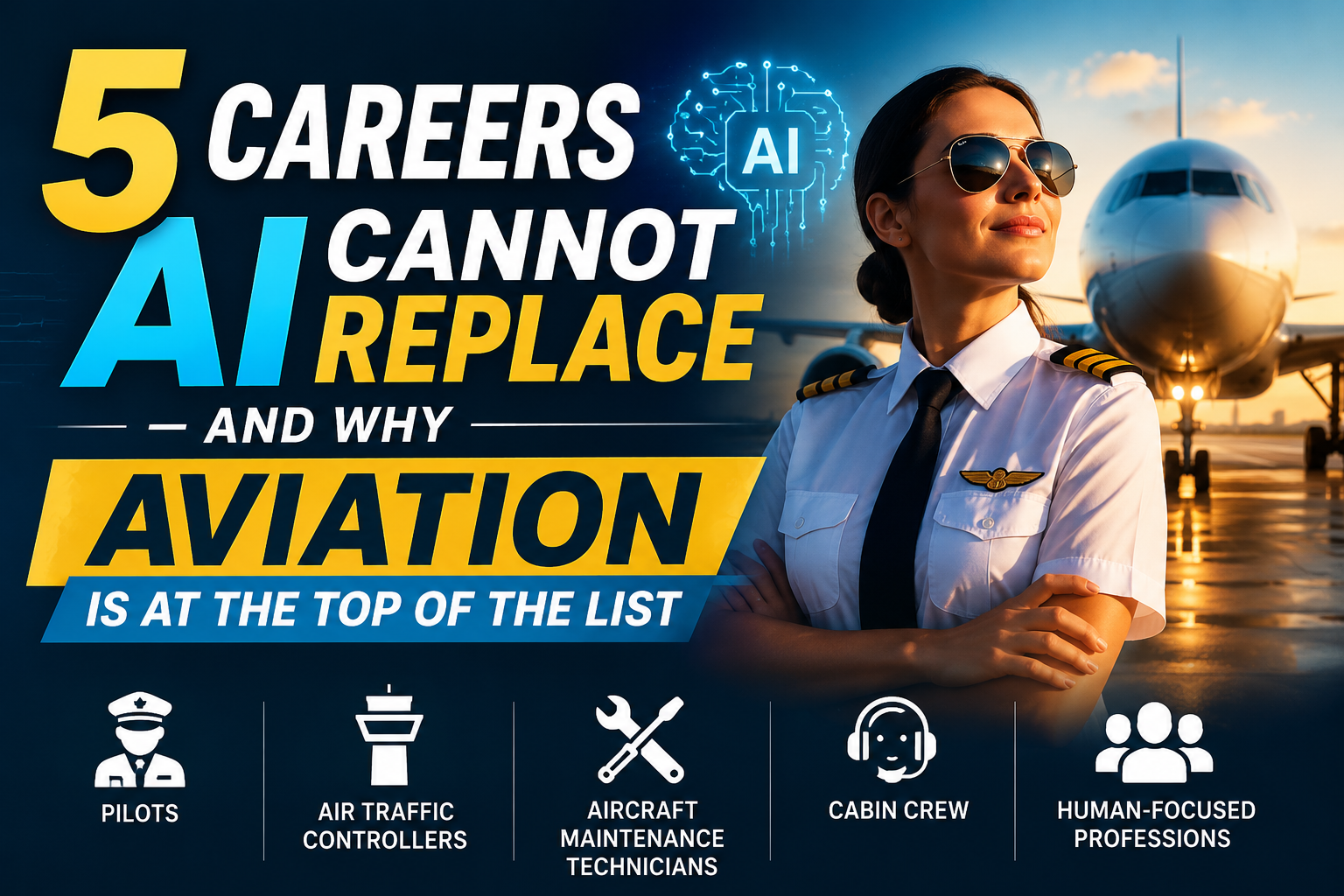
Let’s break down five such careers — and explain why aviation sits firmly at the top of this
list.
Why Some Jobs Are Safe From AI
AI is extraordinarily good at pattern recognition, data processing, repetitive decision-making,
content generation, and tasks with defined inputs and outputs. Where it struggles — and will
continue to struggle for the foreseeable future — is in physical presence, high-stakes
real-world judgment, genuine human connection, and regulatory accountability.
The jobs that involve all four of these elements? AI cannot touch them.
Career 1: Cabin Crew
Let’s be direct. No algorithm is walking down the aisle of a Boeing 787 checking on
passengers, managing an in-flight medical emergency, de-escalating a tense situation, or
making a frightened child feel safe 38,000 feet in the air.
Cabin crew work is rooted in physical presence, emotional intelligence, split-second human
judgment, and accountability. These professionals are trained safety officers. In an
emergency, they are the difference between panic and calm, between chaos and evacuation.
Every interaction they have is unique, every passenger is different, and the environment
itself — a sealed metal tube at altitude — is one where physical human response is not
optional.
Aviation regulators around the world mandate human cabin crew on commercial flights.
That’s not changing. If anything, as air travel volumes grow, the demand for skilled cabin
crew is increasing year on year.
Career 2: Commercial Pilots
The conversation about autonomous aircraft is real, but the reality is far more nuanced.
Flying a commercial aircraft involves regulatory frameworks, emergency decision-making,
physical responsibility for hundreds of lives, and accountability structures that simply cannot
be delegated to an algorithm right now — or for the next several decades.
The aviation industry is one of the most heavily regulated in the world precisely because the
consequences of failure are catastrophic. Regulators, airlines, and the traveling public all
demand human pilots in the cockpit. As air traffic increases and the pilot shortage deepens
globally, trained pilots are among the most sought-after professionals in any industry.
Career 3: Healthcare (Doctors, Nurses, Paramedics)
Doctors and nurses operate in high-stakes, unpredictable, emotionally loaded environments
where the relationship between patient and caregiver is itself part of the treatment. AI can
assist diagnosis. It cannot hold a patient’s hand. It cannot adapt to the thousand unspoken
variables in a clinical consultation. Regulatory and ethical accountability in medicine also
demands a licensed human being be present and responsible.
Career 4: Mental Health Professionals
Therapists, counselors, and psychologists work in the territory of human consciousness —
grief, trauma, identity, relationship, meaning. AI chatbots can provide scripted responses, but
the therapeutic relationship is built on trust, intuition, lived experience, and genuine human
empathy. This is one of the fastest-growing fields globally, and it is one where AI is a tool at
best, never a replacement.
Career 5: Skilled Trades and Physical Roles
(Electricians, Engineers, Aviation
Technicians)
Jobs that require physical dexterity in variable environments — aircraft maintenance
engineers, electricians, plumbers, civil engineers — remain deeply human. Repairing a fault
in an aircraft engine on a runway in changing conditions is not something a robot can reliably
do. The combination of manual skill, real-time problem solving, and physical adaptability
keeps these roles firmly in human hands.
The Bigger Picture: Bet on Human Skills
When you’re choosing a career path in 2025, the smartest question isn’t “what pays well
today?” — it’s “what will still need me in 20 years?”
The answer is: careers that demand physical presence, emotional intelligence, ethical
responsibility, and real-world judgment. Aviation hits every single one of these criteria. It is
one of the very few industries where humans aren’t just preferred — they are legally and
functionally required.
At FlyGlam Academy, we train you for a career that is not only exciting and well-paying today
but genuinely future-proof. Cabin crew, pilot ground school, airport management — these
are not jobs automation is coming for. These are the careers that will outlast the AI wave.
Don’t just choose a career. Choose one that chooses you back — for decades. Talk to FlyGlam Academy today.